
Quick question
Open your telematics dashboard. Pick any forklift. It says: switched on, 8 hours, good utilisation. Feels fine, right?
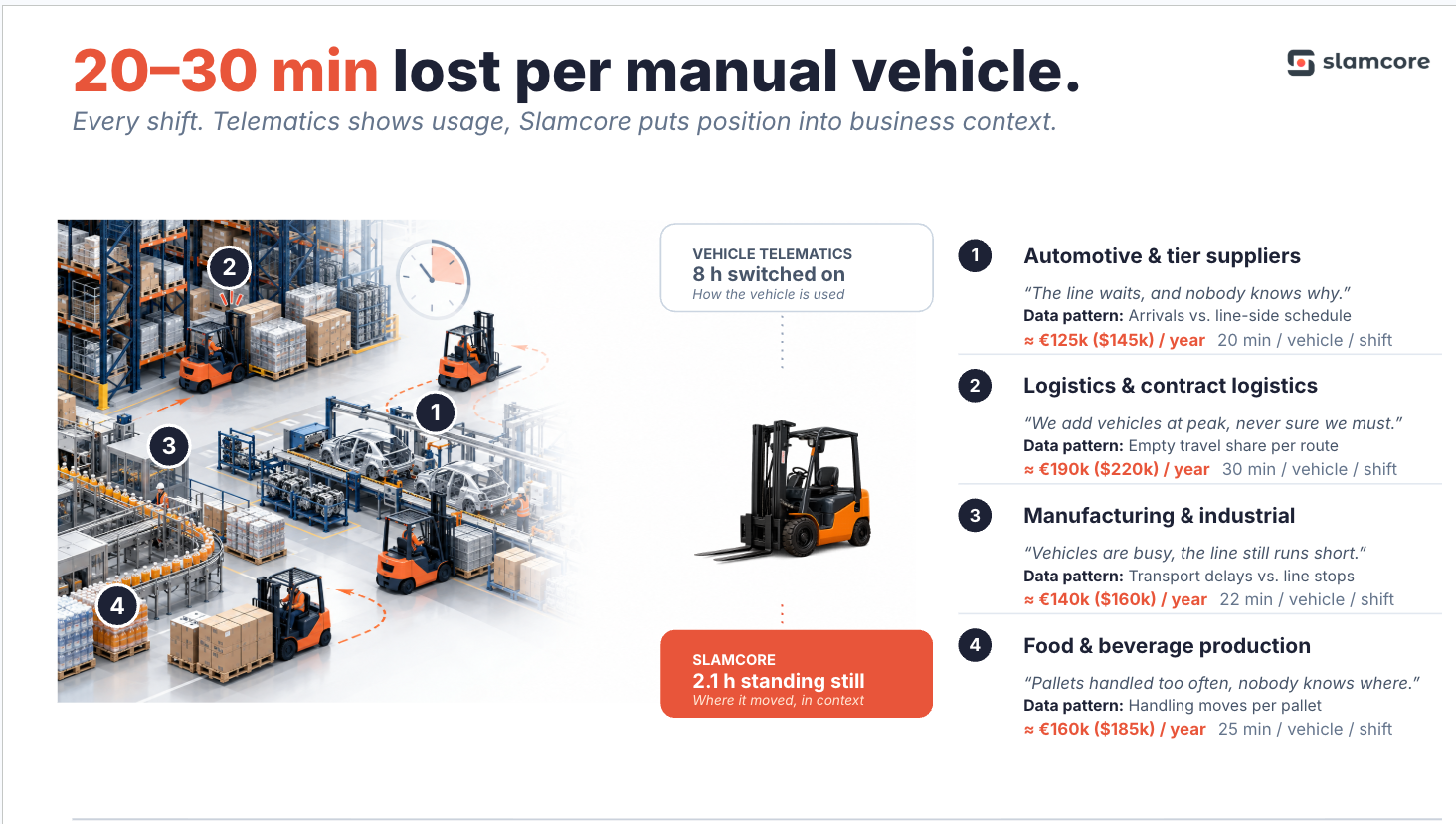
Now ask a different question: how much of those 8 hours did it actually move material? And where was it when it didn’t?
Most teams can’t answer that. Does that sound like your problem?
Telematics tells you about the vehicle
Telematics is great at what it does. It tells you the truck was on, who logged in, how many hours it ran, whether there was an impact, when it needs a service. That’s the vehicle’s story.
But “switched on” isn’t the same as “working”. Engine hours prove the truck was on. They don’t tell you whether it was carrying a pallet, driving empty, or standing in an aisle waiting for something.
Position tells you about the process
Now add one thing: where the vehicle was, every second of that shift, on your floor plan.
Suddenly the same 8 hours look different. Part of that time, the vehicle isn’t broken and isn’t parked. It’s just waiting: for a pick, for a dock, for a handover, for someone to say where to go next.
How much? It varies from site to site, and it’s hard to know until you measure. As a working number, we use 20 to 30 minutes per manual vehicle, per shift. Not a promise, just a sensible starting point for the conversation.
That’s the difference in one sentence: telematics describes the vehicle. Position, in business context, describes the process.
Think in minutes, not in big numbers
Here’s a simple way to make it tangible. Instead of guessing a big total, start with a single minute.
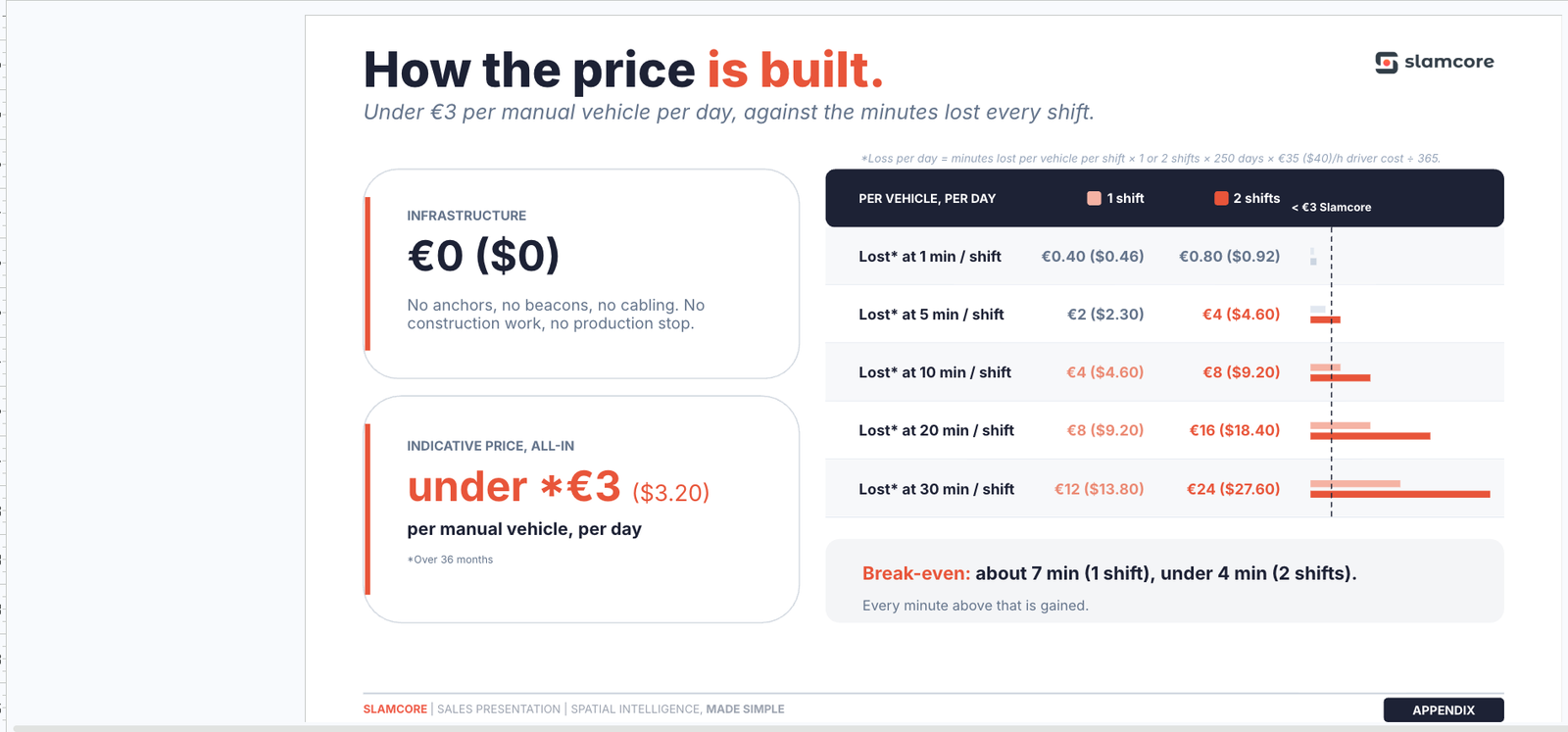
With a working assumption of €35/$40 per driver hour and 250 working days a year, one minute lost per vehicle per shift is worth roughly €150/$170 per vehicle per year. That’s all. One minute.
Now you can do the rest with your own numbers: your minutes, your fleet, your shifts, your labour rate.
Working formula: minutes lost per shift × shifts per day × working days × cost per driver hour ÷ 60.
The point isn’t the exact euro amount. It’s that one minute, times every vehicle, times every shift, times every day, quickly stops being small. And once you can actually see the minutes, you can decide what they’re worth to you.
Where do the minutes hide?
That depends on your business. Four patterns we hear again and again:
- Automotive and tier suppliers. “The line waits, and nobody knows why.” Look at vehicle arrivals versus the line-side schedule.
- Logistics and contract logistics. “We add vehicles at peak, but we’re never sure we must.” Look at the share of empty travel on each route.
- Manufacturing and industrial. “The vehicles are busy, but the line still runs short.” Look at transport delays next to line stops.
- Food and beverage production. “Pallets get handled too often, and nobody knows where.” Look at how many moves each pallet takes.
Same vehicles, different question. That’s what “business context” means: the position only becomes useful when you connect it to the thing your operation actually cares about.
Why we care
At Slamcore, we focus on manual vehicles: forklift trucks, reach trucks, tugger trains and similar vehicles driven by people. They move most of the material in a plant or warehouse, yet they’re the least visible part of the data. We think the next step isn’t replacing telematics. It’s adding the missing piece next to it: where the vehicle went, in the context of your process.
So, back to that dashboard. Your forklift was on for 8 hours. Do you know how many minutes it lost?
We’d love to hear your answer. Let us know.